

%20(1).png)
You May Also Like
_edited.jpg)
The Curious Mind: Why Wonder Keeps the Brain Young, An Applied Guide to Lifelong Learning
Curiosity keeps the brain adaptable and energized. It strengthens learning by activating reward circuits and priming memory. Moderate uncertainty fuels growth. Choosing flexibility over routine thinking keeps intelligence sharp. Bringing this mindset into your relationships deepens connection and adds meaning to everyday life.
The Curious Mind: Why Wonder Keeps the Brain Young, An Applied Guide to Lifelong Learning

Intellectual
December 3, 2025
Key Takeaways
Curiosity Extends Lifespan: Curiosity is the "food that keeps our brain young and healthy," actively promoting Synaptogenesis and Neuroplasticity (Viejo,2020). Teresa Viejo shares that curiosity literally "dilates the death," extending our lifespan by keeping the brain energized and adaptive.
Learning is Biologically Rewarding: Curiosity activates the brain's dopaminergic reward system (specifically the VTA/SN), putting the Hippocampus in a state that is "more likely to retain new information," including surrounding, tangential data (Ranganath, 2019).
Uncertainty is Optimal: We learn most effectively when facing a moderate level of challenge, defined by the Optimal Incongruity Theory (OIT). This approach allows us to face uncertainty with an exploratory mindset (Viejo, 2020).
The Mindset Shift: Adults must actively choose fluid intelligence (novel problem-solving) over the comfortable reliance on crystallized intelligence (accumulated knowledge). This requires changing "from a rigid to a flexible, open, and growing mentality" (Viejo, 2020).
Connection & Fulfillment: Applying curiosity to relationships deepens social engagement and reinforces the fundamental human drive for belonging and a zest for living (Viejo, 2020).
Diclaimer
Welcome! This article is designed to share information and ideas about curiosity and its benefits for the brain and life. It is not intended to replace professional advice, whether medical, legal, financial, or otherwise. Everyone’s situation is unique, and what works well for one person may not be the best fit for another.
If you are considering making important changes based on what you read here, we warmly encourage you to consult with a qualified professional who can provide personalized guidance tailored to your needs. This is especially important if you are currently undergoing treatment, have legal responsibilities, or find yourself in any sensitive circumstances.
As you explore these ideas, please remember to approach others with kindness and respect. Everyone’s journey is their own, so avoid pressuring or forcing anyone to adopt these suggestions. Our goal is to offer helpful insights that inspire and support you, but we cannot guarantee specific results or outcomes.
Thank you for reading with an open heart and mind. May your curiosity lead you to growth, joy, and well-being.
Article Content
Embracing Wonder: Why It’s Time to Stop Settling and Start Exploring
Have you ever felt stuck in a routine, like your mind is on autopilot, and days blend into one another without much spark? It’s a common feeling, especially as life’s demands pile up and the comfort of the familiar seems safer than the unknown. But what if the key to feeling alive, sharp, and joyful lies in something as simple, and powerful, as curiosity?
Curiosity is more than just a fleeting interest; it’s a vital neurological impulse that keeps our brains flexible and our spirits engaged. As Teresa Viejo (2020) reminds us, nurturing this impulse actively promotes neuroplasticity, the physical restructuring of our brain cells, opening ourselves to new experiences, ideas, and connections that enrich every aspect of life.
To truly benefit from curiosity and tap into this cognitive wellspring, it’s time to stop:
Avoiding the Optimal Challenge: You must cease treating uncertainty as a threat. Instead, understand it is the Optimal Incongruity zone necessary for maximal learning and growth.
Settling for Passive Routines: These dull your mind and force an over-reliance on crystallized intelligence, which is easy but does not build the flexible, problem-solving skills of fluid intelligence.
Believing that Curiosity is Only for the Young: It’s a strength we all carry and must deliberately cultivate to keep the VTA/SN and Hippocampus active.
By letting go of these habits, you invite a curious mindset that not only enhances memory and learning but also deepens your connection to the world and the people around you.
In the next part of this article, we’ll explore the practical, evidence-based Action Steps designed to awaken and sustain your curiosity every day, so your brain stays vibrant and your life, endlessly fascinating.
1. Shift Your Mindset: Embracing the Unknown
This pillar focuses on cognitive restructuring, cultivating the mental agility required to frame the unknown not as a source of threat, but as a catalyst for cognitive and emotional growth.
Open the Door to Uncertainty (Cognitive Reframing)
Curiosity is directly proportional to your willingness to tolerate cognitive dissonance. Shifting this mindset from avoidance to acceptance allows the prefrontal cortex to override the anxiety response often triggered by ambiguity, fulfilling the drive for exploration cited by Viejo (2020).
Example (Abstract): When faced with a novel professional challenge, reframe the initial anxiety not as incompetence, but as an acute knowledge gap that your brain is highly motivated to close (Loewenstein, 1994).
Action Steps (Practical Application) | Scenario: Learning Code |
The Anxiety-to-Data Conversion (Purpose: To break down paralyzing ambiguity into manageable, solvable data inputs.) | Worry: "I will never understand this coding syntax." Action: Copy and paste the first five lines of code. Identify and define the single most confusing symbol. |
Micro-Dose Exposure (Purpose: To habituate the brain to uncertainty by achieving rapid, small wins.) | Successfully write and run the "Hello World" program. Document: Predicted anxiety was 7; actual feeling is 3. |
Reframing Statement Discipline (Purpose: To actively replace fixed narratives with observational facts.) | Instead of "I can't code," state: "I am currently gathering information on Python syntax. The compiler is providing me with actionable diagnostic data." |

Transform from Rigid to Flexible Growth (Metacognition)
Rigid thinking represents entrenched neural pathways and a fixed mindset. Cultivating a flexible, growth mindset (Dweck, 2006) requires metacognitive awareness, actively monitoring and controlling your thought processes. Teresa Viejo (2020) advocates for this strategic shift in mentality, which directly fuels creativity.
Example (Abstract): Replace the fixed statement: "I can't do X" with the temporary, growth-oriented query: "What specific prerequisite knowledge am I currently missing to achieve X?"
Action Steps (Practical Application) | Scenario: Learning Code |
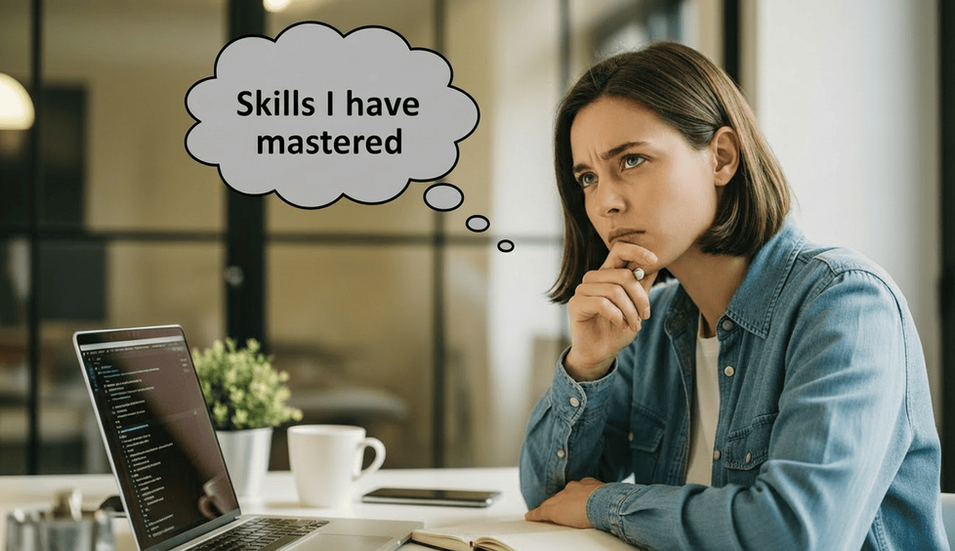
The Belief Audit & Reversal (Purpose: To identify and directly contradict the specific roots of fixed mindset self-talk.) | Negative Script: "I am not mathematically inclined; I will fail at logic puzzles." Action: Write down three non-math skills you mastered that required sustained, complex logical sequencing (e.g., cooking, organizational systems). |
The Reframing Statement Injection (Purpose: To interrupt the negative thought pattern with a positive, effort-based counter-statement.) | Immediately stop the thought. Replace with: "My capacity for logic is growing through this challenge; difficulty is the signal of progress." |
Affirmation as Neural Rehearsal (Purpose: To use rehearsal to strengthen the new, desirable neural pathway.) | Store and review the statement: "My brain capacity expands with every attempt, not just every success." |




Use Curiosity to Overcome Fear and Build Resilience (Adaptive Function)
Curiosity is a powerful antidote to fear because it shifts your attentional bias away from perceived threat and toward exploration. This is crucial in mitigating curiosity anxiety (Loewenstein, 1994), which stems from cognitive strain (Minick, 1998). This investigative approach aligns with the Optimal Incongruity Theory (OIT), motivating exploration at a moderate novelty level to maximize survival-essential learning (Kabat-Zinn, 2022).
Example (Abstract): Apply the "Curious Observer" role to a setback. Ask: "What were the three non-personal systemic factors that contributed to this outcome, and what new data did I acquire?"
Action Steps (Practical Application) | Scenario: Learning Code |
The Fear-to-Information Pivot (Purpose: To shift focus from emotional threat to objective, solvable data.) | Fear arises when an error message appears. Pause 30 seconds. Ask: "What is the precise terminology used by the compiler to describe the fault, and what does it suggest?" |
The Avoidance Quantification (Purpose: To formally acknowledge avoided learning opportunities.) | Once a week, list one coding lesson you skipped. Write down the dependency cost (what subsequent lessons require it). |
Measure Approach and Data Gained (Purpose: To track the approach behavior, not the outcome.) | Commit to attempting one intimidating coding challenge. The success metric is the number of new errors (diagnostic feedback) generated. |

2. Practice Daily Inquiry: The Habit of Mindful Learning
This pillar focuses on implementing highly intentional, ritualistic behaviors that leverage neuroplasticity and the dopamine reward system to sustain continuous learning.
Feed Your Brain: Seek New Knowledge and Question Daily (Dopaminergic System & Creativity)
When you identify a knowledge gap (Loewenstein, 1994), the brain releases dopamine in the midbrain (VTA/SN), which enhances the function of the Hippocampus (memory center). This creates the "curiosity-driven learning effect" (Ranganath, 2019). This dopamine spotlight prioritizes the retention of all concurrent information, serving as the raw material for Divergent Thinking
Example (Abstract): The brain retains related information (e.g., history of science) during a core research session (e.g., astrophysics) due to the dopaminergic spotlight, which directly feeds the raw input for creativity.
Action Steps (Practical Application) | Scenario: Learning Code |
The 10-Minute Epistemic Burst (Purpose: To activate the dopamine-memory spotlight with deep, sustained inquiry.) | Set 10 minutes to focus on the Epistemic Curiosity: How Python handles memory allocation and object referencing. |
Tangent Harvesting (Purpose: To leverage the enhanced memory state for adjacent learning.) | End the 10 minutes by writing down two unrelated, tangential questions (e.g., what is 'garbage collection', how is this different in Java?). |
Crosstalk & Encoding (Purpose: To force retrieval and reorganization, strengthening memory traces.) | Explain memory allocation (using an analogy) to your spouse or friend, strengthening the abstract concept. |

Cultivate Mindful Curiosity and Ritual (Attention & Perception)
Mindful curiosity is an exercise in focused attention, enhancing perceptual resolution, the ability to notice fine details. This practice consciously moves you from diversive curiosity (general novelty seeking) to epistemic curiosity (deep inquiry). Teresa Viejo (2020) emphasizes that curiosity is cultivated by situating ourselves in the present.
Example (Abstract): Focus on non-verbal cues in a meeting to transform a passive experience into an active sociological study.
Action Steps (Practical Application) | Scenario: Learning Code |
The Sensory Deconstruction (Purpose: To improve perceptual resolution by engaging all sensory channels.) | During the first minute of eating lunch, name three flavors (sour, umami, bitter), two textures, and one specific aroma, focusing exclusively on the food. |
High-Value Question Pledge (Purpose: To replace generic questions with ones that drive understanding.) | In a coding forum, commit to asking one high-value "Why" question about the design philosophy behind a specific language feature. |
The Attention Anchor (Purpose: To use classical conditioning to associate a routine cue with focused attention.) | Use the act of putting on headphones as the cue to commit to observing the visual output of the code as it runs, rather than the goal of the code. |


Create Curiosity Triggers in Your Environment (Environmental Nudging)
The environment can be intentionally designed to promote curiosity through "nudges." Novel stimuli promote synaptogenesis (creation of new neural connections) and the production of myelin (Wade, 2009), physically upgrading brain efficiency.
Example (Abstract): Placing a book on the history of mathematics near your coffee machine acts as an environmental trigger for diversive curiosity.
Action Steps (Practical Application) | Scenario: Learning Code |
The 3-Item Novelty Matrix (Purpose: To introduce high-contrast stimuli that force a momentary cognitive shift.) | Place a music theory sheet (adjacent skill), a photo of a complex machine (engineering), and an unfamiliar kitchen tool (diversive) near your workstation. |
The Focused Break Challenge (Purpose: To associate short breaks with intentional, low-effort learning.) | During a loading screen, commit 60 seconds to examining the music theory sheet and identifying one new dynamic symbol (e.g., sforzando). |
Monthly Refresh Discipline (Purpose: To prevent habituation, which eliminates the novelty signal required for dopaminergic activation.) | Set a recurring reminder to swap out all three items once a month. |

3. Deepen Connection: Inner Child and Relationships
This pillar explores the social and affective components of curiosity, recognizing that human connection and psychological safety are core motivators for lifelong learning.
Connect Deeply: Let Curiosity Lead to Meaningful Relationships (Social Cognition)
Applying curiosity to human interaction is an exercise in social cognition, improving empathy and mutual understanding. Genuine curiosity builds trust, which activates the brain's oxytocin system, reinforcing positive social behavior. This approach aligns with the idea that curiosity fosters joy and connection (Viejo, 2020).
Example (Abstract): Ask a high-value, open-ended question that requires narrative depth: "What was the most surprising thing you learned about yourself during your trip?"
Action Steps (Practical Application) | Scenario: Learning Code |
The 80/20 Listening Ratio (Purpose: To reduce time spent planning a response, freeing resources for active perspective-taking.) | In a conversation with a family member, commit to 80% listening. Ask a follow-up question that starts: "What I hear you saying is X. What emotion is tied to that experience for you?" |
"The Why" Perspective Shift (Purpose: To access the underlying motivation/data behind a belief, reducing confirmation bias.) | When a friend dismisses a political view, ask: "What is the core value you feel is most affirmed by your viewpoint?" |
Reward Reflection (Affective) (Purpose: To reinforce the social reward of genuine connection.) | After the conversation, internally name the positive feeling: "I feel socially rewarded because they shared something personal, strengthening our bond." |


Nurture Your Inner Child (Intrinsic Motivation)
Childlike curiosity is driven by intrinsic motivation, the inherent satisfaction derived from the activity itself. Reconnecting with this state means deliberately suspending the adult critical filter and fear of failure. Teresa Viejo (2020) reminds us that our capacity to learn is never lost.
Example (Abstract): Spend 30 minutes attempting an activity you haven't done since childhood. Focus solely on the process and the sensory experience, not the product.
Action Steps (Practical Application) | Scenario: Learning Code |
Schedule "Incompetence Play" (Purpose: To deliberately engage in low-stakes tasks to rebuild tolerance for error.) | Block out one hour this week to attempt to play a simple song on a borrowed or digital instrument, accepting all dissonant sounds. |
Suspend Judgment Protocol (Purpose: To disassociate self-worth from performance outcomes.) | If the thought "This sounds terrible" arises, label it: "Fixed Mindset" and return focus to the feeling of your fingers on the keys (the process). |
Measure Intrinsic Flow (Purpose: To track the state of absorption, which is the purest signal of intrinsic motivation.) | Briefly rate your enjoyment (1-10) of the spontaneous creation, noting how long you were able to sustain pure focus without checking a device. |




4. Sustain the Practice: Rest and Lifelong Commitment
This pillar emphasizes the homeostatic balance required for curiosity, ensuring that the necessary cognitive resources are managed for long-term psychological and neurological health.
Balance Curiosity with Rest (Memory Consolidation)
Curiosity is highly resource-intensive. Rest and sleep are essential for memory consolidation, the process by which newly acquired information is stabilized. Jon Kabat-Zinn (2022) emphasizes the importance of rest and renewal.
Example (Abstract): Rest is a direct investment in the knowledge sought, as the brain processes and retains the new information during sleep.
Action Steps (Practical Application) | Scenario: Learning Code |
The Ocular Decompression Break (Purpose: To reduce strain on the visual cortex after focused work, conserving cognitive resources.) | After any session lasting over 45 minutes, perform a 10-minute break with an eyes-closed meditation to reduce all sensory input. |
Digital Sunset Protocol (Purpose: To reduce cognitive load from blue light and stimulating content, optimizing sleep-dependent memory consolidation.) | Institute a 20-minute "Digital Sunset" before bed, replacing the screen with stretching, focusing on the breath. |
Fatigue Signal Check-In (Purpose: To formalize the recognition of energy depletion before reaching burnout.) | When frustration hits, immediately commit to a 5-minute pause and drink a glass of water, noting the precise feeling (e.g., tension in the shoulders) that preceded the burnout. |




Make Curiosity Your Lifelong Companion (Lifespan Intelligence)
Sustaining curiosity requires a conscious commitment device because adults rely more on crystallized intelligence (accumulated knowledge) over fluid intelligence (novel problem-solving capacity). The premise requires a deliberate commitment to effortful learning to maintain cognitive flexibility. Teresa Viejo’s (2020) ultimate message is to continually feed your curiosity.
Example (Abstract): Establish an annual Learning Contract with yourself, outlining specific skills to acquire (fluid intelligence) and novel environments to explore, making the practice intentional and measurable.
Action Steps (Practical Application) | Scenario: Learning Code |
The Annual Epistemic Thesis (Purpose: To create a high-level, guiding question that directs resource allocation for the year.) | Write the question: "How does machine learning truly impact individual creative expression and authorship, and what are its technical limits?" |
The Quarterly Commitment Review (Purpose: To use scheduled accountability as a commitment device.) | Place a recurring calendar event every three months labeled "ML/Art Review: Assess Skill Gaps and Next Learning Module." |
The Public Pledge (Optional) (Purpose: To leverage positive external pressure to maintain momentum.) | Share your "ML/Art Thesis" with a small study group or an online community, setting a soft deadline for a presentation. |

5. Celebrate Discoveries: Building Momentum
This final pillar utilizes positive reinforcement to strengthen the neural circuits supporting curiosity, ensuring the motivation is sustained over the long term.
Celebrate Small Discoveries (Positive Reinforcement)
Acknowledging progress acts as positive reinforcement, triggering the reward centers in the brain and making future curious behavior more likely. Recognizing micro-wins is essential for maintaining motivation, ensuring you put "life into your curiosity to extend your own life" (Viejo, 2020).
Example (Abstract): Celebrate the moment you successfully found a complex piece of information, reinforcing the behavior that led to the discovery.
Action Steps (Practical Application) | Scenario: Learning Code |
The 60-Second Specific Insight Log (Purpose: To formalize the achievement and ensure the specific data point is consciously reinforced.) | End the day by writing: "Today I learned that Python uses 'indentation' instead of brackets to define code blocks." |
The Verbalized Win (Social Reinforcement) (Purpose: To leverage the social reward pathway for a dopamine hit.) | Text a friend: "I finally figured out how to use the 'for' loop in my script, it took three hours!" |
Micro-Reward Pairing (Classical Conditioning) (Purpose: To condition the brain to associate cognitive effort with immediate, non-food-based pleasure.) | Immediately after solving a difficult bug, reward yourself with 60 seconds of watching a funny video, pairing the struggle with a brief, pleasurable break. |

The Journey of the Curious Mind
You've completed the blueprint for cultivating a curious, flexible, and resilient mind. The true strength of this guide lies not in mastering every single protocol, but in understanding that curiosity is a neurological habit, not a personality trait. You now know that engaging in mindful inquiry boosts dopamine (reward), strengthens the Hippocampus (memory), and physically builds new neural pathways through synaptogenesis (Wade, 2009).
This is a journey of small, sustainable acts. We've replaced the paralyzing fear of incompetence with the actionable Curious Observer role, transforming uncertainty from a threat into an Optimal Incongruity, the perfect challenge zone for growth.
Remember to honor your effort, not just your output. Every time you consciously choose the Reframing Statement Discipline over a fixed thought, every 10-Minute Epistemic Burst, and every intentional Micro-Dose Exposure to uncertainty, you are performing maintenance on your mind's most powerful engine: its capacity to wonder.
Progress Over Perfection: A Call to Self-Compassion
It’s easy to fall back into routine; the brain is wired for efficiency and seeks cognitive closure. Be gentle with yourself when this happens. Self-compassion is the foundation of resilience. The goal is not to eliminate fear, but to choose curiosity alongside the fear. You are not striving for an immediate, perfect result, but for measurable progress in your ability to observe, question, and engage.
Your Gentle Call to Action
To begin strengthening your curious mind, choose one of the following pressure-free micro-commitments right now:
The Single Refocus: Identify one habitual negative script (e.g., "I can't do this") and store one single, growth-oriented counter-statement (e.g., "Difficulty is the signal of progress") in your phone notes.
The 60-Second Specific Insight Log: Before the end of today, take 60 seconds to write down the most interesting, specific new fact or insight you acquired.
Trust the process, embrace the micro-win, and keep asking why.
References
Cialdini, R. B., Kenrick, D. T., & Baumann, D. J. (1994). Social psychology: Goals in interaction. HarperCollins College Publishers.
Dweck, C. S. (2006). Mindset: The new psychology of success. Random House.
Gruber, M. J., & Ranganath, C. (2019). How curiosity enhances hippocampus-dependent memory: The prediction, appraisal, curiosity, and exploration (PACE) framework. Trends in Cognitive Sciences, 23(12), 1010–1021. https://doi.org/10.1016/j.tics.2019.08.006
Kabat-Zinn, J. (2022, July 29). Befriending the silence: A 30-minute meditation with Jon Kabat-Zinn | Episode 2 [Video]. YouTube. https://www.youtube.com/watch?v=480L7_pE2qQ
Loewenstein, G. (1994). The psychology of curiosity: A review and reinterpretation. Psychological Bulletin, 116(1), 75–98. https://doi.org/10.1037/0033-2909.116.1.75
Minick, P. (1998). The social construction of knowledge. Kluwer Academic Publishers.
Viejo, T. (2020, February 11). La curiosidad rejuvenece [Video]. YouTube. https://www.youtube.com/watch?v=EuvE3Irw96k
Wade, N. J. (2009). Myelin, development, and plasticity. Developmental Psychology, 45(6), 1629–1638. https://doi.org/10.1037/a0017106