

%20(1).png)
You May Also Like
Sleep your best, Live your best
Sleep is a biological necessity, not a luxury. Chronic sleep loss damages health, emotions, and productivity. Quality sleep detoxifies the brain, strengthens emotional resilience, and protects long-term cognition. Consistent sleep timing matters as much as hours slept. Reframing sleep as an investment, not a weakness, is essential for mental clarity, physical vitality, and sustained performance.
Sleep your best, Live your best

Physical
February 8, 2026
Key Takeaways
The Global Epidemic: Approximately one-third of the global population is failing to reach the required 7–9 hours of sleep. In the US alone, this results in a $411 billion annual loss in economic productivity (The Diary Of A CEO, 2023).
Biological Detox: Sleep is the only time the brain activates the Glymphatic System, a "waste management" process that flushes out neurotoxins like beta-amyloid, which are linked to Alzheimer’s disease (Walker, 2017).
Regularity as Medicine: Maintaining a consistent sleep-wake schedule (the "Anchor") can reduce all-cause mortality risk by nearly 50%, demonstrating that regularity is as vital as duration (After Skool, 2025).
Emotional Resilience: Dream sleep (REM) acts as "emotional first aid," stripping away the painful sting of difficult memories so you can wake up with a neutral perspective.(The Diary Of A CEO, 2023).
The "Sleep Machismo" Trap: We must shift our cultural mindset, stop viewing sleep as a "cost" of productivity and start seeing it as the primary investment in tomorrow’s cognitive and physical vitality. (Jay Shetty Podcast, 2025).
Disclaimer
This article is intended to share information, ideas, and suggestions for general purposes. It is not professional advice—medical, legal, financial, or otherwise.
Everyone’s situation is unique, and what works well for one person may not be the right fit for another. If you are considering making important changes based on what you read here, we warmly encourage you to consult with a qualified professional who can provide guidance tailored to your individual needs.
If you are currently receiving treatment, have legal responsibilities, or are navigating sensitive circumstances, please exercise extra care and seek appropriate support before applying any ideas from this article. Above all, we invite you to approach these topics with kindness and respect for yourself and others.
While we hope this article offers helpful insights, please know that no guarantees of specific results or safety can be made. Your well-being matters deeply, and taking thoughtful, compassionate steps is the most important part of your journey.
Article Content
Pillar 1: Mastering Your Schedule
Calculate Your "Biological Anchor"
Pillar 2: Creating a Sanctuary
The Thermal Trigger: Dropping Core Temperature
The Optical Environment: Protecting Melatonin
Pillar 3: Managing Inputs & Biology
The Caffeine "Half-Life" Protocol
The Alcohol "REM-Blocker" Audit
Pillar 4: The Psychology of Sleep
The "Cognitive Shuffle" (Scrambling the Logical Brain)
The "3-Hour Brain Dump" (Offloading Working Memory)
We are currently living through a silent, global sleep-loss epidemic. According to the World Health Organization, approximately two-thirds of adults in developed nations fail to obtain the recommended seven to nine hours of sleep. Sleeping less than 7 hours is associated with higher levels of p-tau and t-tau proteins, the primary biomarkers for Alzheimer's risk. People with lower "Slow Wave Sleep" (Deep Sleep) show measurable brain atrophy (shrinkage) in regions vulnerable to dementia (Barcelonaβeta Brain Research Center, 2025).
Why Sleep Matters More Than You Think, And What to Stop Doing Today
Have you ever found yourself lying awake at night, heart racing with worries about tomorrow, or waking up feeling exhausted despite spending hours in bed? You’re not alone. Many of us treat sleep as an optional luxury, blaming busy schedules for our exhaustion. But the truth is stark: Sleep is not a passive state; it is an active, vital process that restores your body, sharpens your mind, and heals your emotions.
Matthew Walker, one of the world’s leading sleep experts, calls it “the single most effective thing to reset brain and body health” (The Diary Of A CEO, 2023). When we neglect sleep, we don't just feel "tired", we pay a biological tax that includes increased risks of heart disease, diabetes, impaired creativity, and emotional instability.
To begin your transformation, you must first clear the path. Here are the three most common "sleep disruptors" you must stop today:
Stop viewing sleep as “wasted time.” It is not a cost to your productivity; it is the primary investment in your future self.
Stop using alcohol or marijuana as sleep aids. While these substances may "knock you out," they are sedatives that block critical REM sleep, leaving you emotionally fragile and cognitively foggy the next day (Penguin Books UK, 2019).
Stop fighting your biological clock. Ignoring your natural chronotype (whether you are a Lark or an Owl) or maintaining an inconsistent schedule creates "social jetlag," which triggers chronic sickness and metabolic disease (Jay Shetty Podcast, 2025).
By shifting your mindset from "sleeping is for the weak" to "rest is for the elite," you unlock a version of yourself that is more vibrant and resilient. Your journey to thriving starts now, built upon the following Four Pillars of Restorative Sleep.
Pillar 1: Mastering Your Schedule
Consistency is the foundation of the biological clock.
The human body operates on a roughly 24-hour internal clock known as the circadian rhythm, governed by the Suprachiasmatic Nucleus (SCN) in the brain. This master clock is reset daily by environmental cues, primarily "viewable" light. Research shows that "regular sleepers had a 49% reduced risk of mortality compared to irregular sleepers" (After Skool, 2025).
1. Calculate Your "Biological Anchor"
Your body processes sleep in 90-minute cycles. Waking up in the middle of a deep sleep cycle causes "sleep inertia," leaving you groggy for hours. To find your ideal bedtime, work backward from your required wake-up time in 90-minute increments.
The Goal: 5 cycles (7.5 hours) or 6 cycles (9 hours).
The Math: If you must wake at 7:00 AM, your "Anchor" bedtime is 11:30 PM.
Action Step: Set a recurring alarm for 7:00 AM that you commit to every day, including Saturdays. This "anchors" your Suprachiasmatic Nucleus (SCN), the master clock in your brain.


2. The "First Light" Protocol
Your circadian rhythm is not just internal; it is "set" by external light. When sunlight hits the melanopsin receptors in your eyes, it triggers a cortisol pulse that wakes you up and, crucially, starts a 14-hour timer for your body to begin producing melatonin at night.
Practical Execution: Within 30 minutes of waking, go outside.
The Cloud Factor: On a clear day, spend 10 minutes outside. On a cloudy day, spend 20 minutes. Even through clouds, the "Lux" (light intensity) is significantly higher than any indoor light.
Note: Do not wear sunglasses for this specific 10-minute window; the light needs to reach your retinas to signal the brain (Walker, 2017).

3. Align with Your Chronotype: The Genetic Blueprint
Identify if you are a Morning Lark or a Night Owl. This is your internal biological personality, determined by the PER3 gene and is difficult to change. It dictates when you are naturally programmed to be awake or asleep.
A. Which one are you?
Morning Larks (~40%): You wake at dawn with high energy but "crash" early (9:00 PM).
Night Owls (~30%): You hit your peak in the late afternoon. You struggle to sleep before midnight and feel "drugged" if forced to wake early.
In-Betweeners (~30%): You are flexible and adapt easily to a standard 9-to-5 schedule.
B. The Danger: "Social Jetlag"
When a Night Owl is forced to wake at 6:00 AM for work, they suffer from Social Jetlag. This "yo-yo" effect, being exhausted all week and sleeping in on weekends, confuses your brain's master clock and causes chronic brain fog.
How to "Hack" Your Clock:
If your work schedule doesn't match your biology, use these tools to shift your rhythm:
If you are a... | Morning Strategy | Evening Strategy |
Night Owl (Must wake early) | The Morning Blast: Get 15 mins of sun or use a 10,000 Lux lamp at breakfast. This "kills" melatonin instantly. | The Deep Fade: Strictly use only amber/warm lamps after 8:00 PM to force an early wind-down. |
Morning Lark (Must stay up late) | The Standard: Morning sun is fine, but avoid over-caffeinating too early. | Blue Light Utilization: Use screens or bright lights in the early evening to trick your brain into thinking it's still daytime. |
The "Vacation Test": To find your true North, see when you naturally wake up after 4 days without an alarm. If you sleep from 2:00 AM to 10:00 AM, you are a definitive Night Owl. Use the Morning Blast and Deep Fade to shift your window earlier so you can thrive during the work week.

4. Strategic Napping: The 20/90 Protocol
Napping acts as a biological "reset," increasing productivity by 34% and alertness by over 50% (The Diary Of A CEO, 2023). To benefit, you must wake up during Light Sleep to avoid "sleep inertia", that heavy, groggy feeling caused by waking during a deep cycle.
The 20-Minute "Power Nap":
Goal: Instant alertness and focus.
Why: You wake up before your brain enters the "Deep Sleep" stage. This prevents Sleep Inertia (that heavy, groggy feeling).
Practical Tip: Set your alarm for 25 minutes (5 mins to fall asleep + 20 mins of rest).
The 90-Minute "Full Cycle":
Goal: Emotional recovery and creativity.
Why: You complete a full biological loop (Light-Deep-REM). You wake up naturally as the cycle finishes.
Practical Tip: Use this only if you have a significant sleep debt from the night before.
The "Danger Zone" (45–60 mins): Avoid waking up during this window. This is the peak of deep sleep; waking here causes intense brain fog. If you only have 45 minutes, take a 20-minute nap and spend the rest of the time just resting with your eyes open.
Pro-Tip: The "Coffee Nap" > Drink a coffee immediately before a 20-minute nap. Caffeine takes ~25 minutes to hit your system. You will wake up exactly as the caffeine kicks in for a "double-shot" of energy.


Pillar 2: Creating a Sanctuary
Your environment should act as a "cave": cold, dark, and quiet.
You must transform your bedroom from a multipurpose living space into a specialized "biological cave." The goal is to manipulate three environmental variables, Temperature, Light, and Sound, to trigger the brain's transition into deep NREM sleep and activate the Glymphatic System where cerebrospinal fluid flushes out metabolic waste, specifically Beta-amyloid, a protein associated with Alzheimer’s disease (Walker, 2017).
5. The Thermal Trigger: Dropping Core Temperature
Your brain needs to drop its internal temperature by about 1°C (2-3°F) to initiate sleep. If your core stays warm, your brain stays in a state of "metabolic alert."
The Practical Protocol: Set your thermostat to 18°C (65°F). This may feel chilly initially, but it allows your body to radiate heat effectively.
The "Hot Bath" Paradox: Take a hot shower or bath 60 minutes before bed. This seems counterintuitive, but it causes vasodilation, blood vessels in your hands and feet open up, bringing heat to the surface. When you step out, that heat "dumps" into the environment, causing your core temperature to plummet, which acts as a biological trapdoor into sleep (After Skool, 2025).
Foot Management: If you have cold feet, wear socks to bed. Warming the feet dilates the vessels there, which actually helps the rest of your body cool down faster.

6. The Optical Environment: Protecting Melatonin
Your eyes contain specialized cells called Intrinsically Photosensitive Retinal Ganglion Cells (ipRGCs). These are hypersensitive to blue light (450-480nm) and send a direct "stay awake" signal to your brain's master clock.
The "Amber Shift" Protocol: Two hours before bed, turn off all overhead "cool white" LED lights. Switch to floor lamps with warm-toned, amber, or red bulbs. These wavelengths do not suppress melatonin nearly as aggressively.
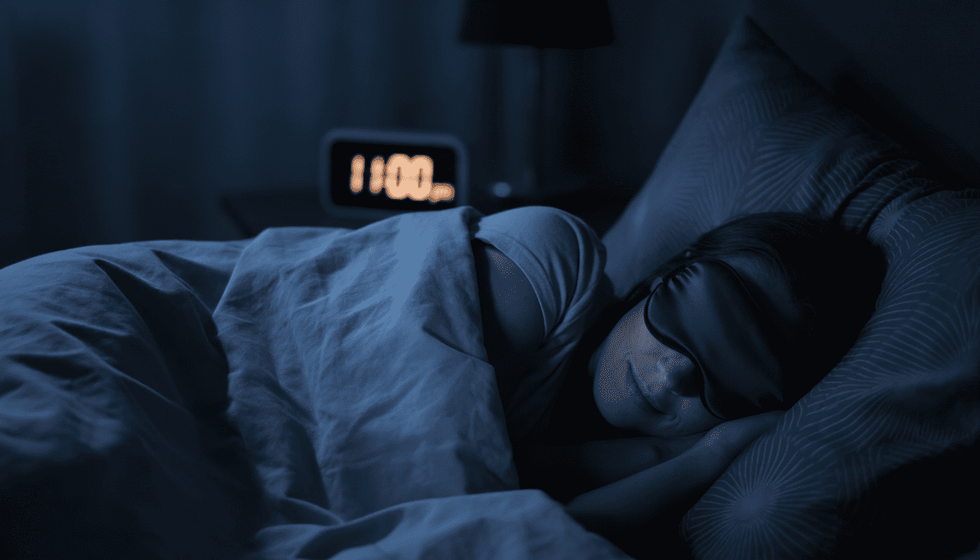
The Blackout Audit: Sit in your bed at night with the lights off. Can you see your hand in front of your face? If so, the room is too bright. Use blackout curtains or a high-quality silk eye mask to ensure total darkness. Even a tiny LED from a power strip can disrupt sleep architecture through the eyelids (Noyed, 2025).


7. The Acoustic Shield: Utilizing Pink Noise
While complete silence is ideal, sudden "peak" noises (a car horn or a door closing) trigger the sympathetic nervous system, causing micro-awakenings that prevent you from reaching Stage 3 Deep Sleep.
The Pink Noise Advantage: Unlike the static hiss of white noise, Pink Noise (like falling rain or rustling leaves) has a frequency profile that decreases in power as the frequency increases. Research shows this can synchronize brain waves into a "Slow Wave" state (Walker, 2017).
Practical Execution: Use a non-looping pink noise machine or a high-fidelity app. Position the speaker between your bed and the source of potential noise (like a window facing a street) to create an "acoustic barrier."
8. Biological Engineering: Nasal Breathing
If you wake up with a dry mouth, you have likely been "mouth breathing." This reduces oxygen saturation and triggers the "stress" branch of your nervous system.
The Mouth Taping Protocol: This sounds extreme but is highly effective. Apply a small, vertical strip of gentle surgical tape (like Micropore) over the center of your lips. This ensures you utilize Nasal Breathing, which filters air, produces Nitric Oxide, and significantly improves sleep quality (Nestor, 2020).

Pillar 3: Managing Inputs & Biology
What you consume during the day dictates how you recover at night.
You must treat your body like a chemical laboratory. The goal is to manage the "pharmacology" of what you ingest to ensure that by the time your head hits the pillow, your brain is flooded with Adenosine (sleep pressure) and cleared of stimulants and metabolic heat.
9. The Caffeine "Half-Life" Protocol
Caffeine is an adenosine antagonist. It doesn't give you energy; it simply "muffles" the signal that you are tired by sitting in the brain's adenosine receptors.
The Science: Caffeine has a half-life of about 5–6 hours and a "quarter-life" of 10–12 hours. If you have a cup of coffee at 2:00 PM, 25% of that caffeine is still active in your brain at midnight.
Practical Execution: Establish a "Hard Stop" 10 hours before your anchor bedtime.
Example: If your bedtime is 11:00 PM, your last sip of caffeine (including tea and soda) must be at 1:00 PM.
The "90-Minute Delay": Do not drink caffeine the moment you wake up. Wait 90 minutes to allow your brain to naturally clear the remaining adenosine from the night before. This prevents the "afternoon crash" when the caffeine eventually detaches from the receptors (Penguin Books UK, 2019).
10. The Alcohol "REM-Blocker" Audit
Alcohol is a sedative, but sedation is not sleep. Sedation is closer to a light form of anesthesia. Alcohol fragments your sleep, leading to dozens of "micro-awakenings" you won't remember, and it effectively "paralyzes" your REM sleep.
The Science: REM sleep is when you process emotions and integrate memories. Blocking it leads to increased anxiety and irritability the next day (The Diary Of A CEO, 2023).
Practical Execution: If you choose to drink, follow the "1-for-1" and "3-Hour" rules.
Finish your last drink at least 3 hours before bed to give your liver time to metabolize the ethanol.
Drink a full glass of water for every alcoholic beverage to mitigate the dehydrating effects that trigger middle-of-the-night wakefulness.
11. The Metabolic "Cool Down" Window
Digesting a large meal requires a significant increase in blood flow to the gut, which raises your core body temperature. As we learned in Pillar 2, sleep requires your temperature to drop.
The Science: High-protein or spicy meals late at night keep your "metabolic furnace" burning, preventing you from reaching the "Slow Wave" deep sleep necessary for the glymphatic cleaning cycle (After Skool, 2025).
Practical Execution (The 3-Hour Fast): Finish your last large meal 3 hours before sleep. This ensures your body is radiating heat away rather than generating it.
The "Sleep-Prime" Exception (60 Minutes Before Bed): If you are truly hungry, do not ignore it, the stress of hunger (ghrelin) can keep you awake. Instead, consume a small "Sleep Snack" exactly 60 minutes before bed.
The "Precursor Pairing" Recipe: Turn your snack into a biological sedative.
Recipe: One kiwi sliced over a small portion of Greek yogurt topped with a tablespoon of pumpkin seeds.
Why it works: The pumpkin seeds provide Magnesium and B6, the yogurt provides Tryptophan, and the kiwi provides Serotonin and the gentle carb-nudge needed to push those nutrients into the brain without causing a massive thermal spike.
12. The Sleep-Synthesis Protocol: Micronutrients & Precursors
You cannot reach deep sleep if your body is missing the raw materials for "sleep chemicals." You must treat your evening meal as a way to prime the brain for hormone production.
The Vitamin B6 Catalyst: * The Science: Vitamin B6 is the critical co-factor required to synthesize GABA (the "off switch") and Serotonin. Deficiencies are linked to fragmented sleep and psychological stress.
Execution: Ensure your dinner includes B6-rich foods like chickpeas, salmon, or bananas to prime your brain's "calm-down" chemistry.
Micronutrient Loading (Magnesium & Zinc): * The Science: Magnesium is the "calming" mineral. It helps the brain transition into a parasympathetic state by regulating GABA. Zinc supports the metabolism of melatonin.
Execution: Increase intake of magnesium-rich foods (spinach, pumpkin seeds, almonds) during dinner. If your doctor approves, Magnesium Glycinate taken 60 minutes before bed acts as a natural "volume knob" for the central nervous system (Rondanelli et al., 2011).
The Tryptophan Catalyst:
The Science: Tryptophan is the amino acid precursor to melatonin. To cross the blood-brain barrier, it often needs a small insulin spike from complex carbohydrates.
Execution: Combine a protein with a slow-burning carb (e.g., walnuts with a kiwi or a small bit of sweet potato).
The Hydration "Taper":
Execution: Stop large water intake 2 hours before bed to prevent Nocturia (waking up to use the bathroom). If thirsty, take small sips with a pinch of sea salt; electrolytes help cells "hold" hydration rather than sending it to the bladder.


Pillar 4: The Psychology of Sleep
A quiet mind is the gateway to restorative rest.
Stress triggers the release of cortisol, which is the biological opposite of melatonin. Sleep, specifically REM sleep, acts as a form of overnight psychotherapy (The Diary Of A CEO, 2023). You must address the neurobiological "switch" between your Sympathetic Nervous System (fight or flight) and your Parasympathetic Nervous System (rest and digest). Sleep is not a light switch you can simply flip; it is a physiological ramp-down. If your brain is producing Noradrenaline, the chemical cousin of adrenaline, sleep is biologically impossible.
13. The "Cognitive Shuffle" (Scrambling the Logical Brain)
When you lie awake, your brain is usually in "linear" mode, thinking about causes, effects, and consequences. This keeps your brain in Beta-wave activity. To sleep, you need to transition into Alpha and Theta waves, which are characterized by non-linear, "dream-like" imagery.
Practical Execution: Pick a neutral word with at least 5-6 non-repeating letters (e.g., "PLANET").
P: Visualize a Penguin, then a Pizza, then a Paperclip. Spend 5-10 seconds on each until the image is vivid.
L: Visualize a Lion, then a Lamp, then a Ladder.
A: Visualize an Apple, then an Anchor, then an Ant….
Why it works: By forcing your brain to visualize random, unrelated objects, you "scramble" the logical loops that keep you awake. This mimics the biological onset of dreaming, tricking the Suprachiasmatic Nucleus (SCN) into believing the sleep process has already begun.
14. The "3-Hour Brain Dump" (Offloading Working Memory)
A primary driver of insomnia is "Incomplete Task Anxiety" or the Zeigarnik Effect, the tendency of the brain to keep "open loops" active until they are resolved. If you don't offload these, your brain will keep them in its "working memory" all night.
Practical Execution: At least 2–3 hours before bed (not right before bed), sit down with a physical notebook.
The List: Write down every task, worry, or "to-do" for the next day. Be specific.
The Close: Next to each item, write one tiny step you will take tomorrow to address it.
The Science: A clinical study from Baylor University found that people who wrote a specific to-do list for 5 minutes fell asleep 33% faster than those who wrote about what they had already accomplished. Writing it down signals to the brain that the information is "archived," allowing the prefrontal cortex to finally go offline.

15. The 15-Minute "Stimulus Control" Rule
One of the most damaging things you can do is lie in bed while frustrated. This creates a Pavlovian association between your bed and the feeling of anxiety. Over time, your brain learns that "Bed = Stress."
Practical Execution: If you have been in bed for roughly 15-20 minutes and feel the "wired" sensation:
Get Out of Bed: Go to a different room. Keep the lights very low (amber or red light only).
Low-Dopamine Activity: Do something tactile and boring. Fold laundry, read a physical book (no screens), or listen to a calm, non-engaging podcast.
The Trigger: Only return to bed when you feel the physical signs of sleepiness (heavy eyelids, yawning, or nodding off), not just when you are "tired."
Why it works: This protects the sanctity of the bed, ensuring your brain maintains a 100% association between the mattress and sleep, rather than wakeful rumination (Walker, 2017).
16. Box Breathing (Physiological Override)
If your heart rate is above 60–70 beats per minute, your body thinks there is a threat. You can manually override this through the Vagus Nerve.
Practical Execution: 1. Inhale through the nose for 4 seconds. 2. Hold for 4 seconds. 3. Exhale slowly through the mouth (like breathing through a straw) for 4 seconds. 4. Hold empty for 4 seconds.
Why it works: This specific rhythm increases Heart Rate Variability (HRV) and forces the nervous system out of "Sympathetic" (stress) and into "Parasympathetic" (rest) mode.

Real-World Obstacles: What if You Can’t Follow the Rules?
Not everyone has a predictable 9-to-5 schedule. If you are a parent or a shift worker, the "perfect" 8-hour window might be impossible. Here is how to build Sleep Resilience:
For Parents/Interrupted Sleep: Focus on "Sleep Cycles" (90-minute blocks). If you can't get 8 hours, aim for multiples of 90 minutes (e.g., 6 hours or 7.5 hours) to avoid waking up in the middle of deep sleep.
For Shift Workers: Use blackout curtains and "Light Therapy." Expose yourself to very bright light at the start of your "day" (even if it's 8:00 PM) and wear high-quality blue-light-blocking glasses on the drive home in the morning to protect your melatonin.
When to Seek Help: If you experience loud snoring, gasping, or chronic daytime exhaustion despite "sleeping" 8 hours, consult a physician. Conditions like Sleep Apnea are medical issues that lifestyle changes alone cannot fix.
Your Path to a Rested Life
Embracing the power of sleep is not about achieving a "perfect" eight-hour window every single night. It is about honoring the biological rhythms that keep you vibrant, creative, and emotionally resilient. As we have explored, sleep is the ultimate act of self-care, a nightly ritual where your brain flushes away the debris of the day and your heart processes the weight of your experiences.
By understanding the mechanics of your "master clock," the cleansing power of the glymphatic system, and the simple magic of nasal breathing, you are no longer just "going to bed." You are stepping into a sanctuary of healing.
Progress Over Perfection
There will be nights when life gets in the way, when a child needs you, a deadline looms, or your mind simply won't quiet down. In those moments, remember to lead with self-compassion. One night of restless sleep does not erase your progress. The goal is not a rigid streak of perfection, but a gentle, consistent return to these healthy foundations. Every time you choose to dim the lights an hour early or step into the morning sun, you are casting a vote for your future health and happiness.
A Small Step for Tonight
You don't have to overhaul your entire life at once. Real, lasting transformation starts with a single, pressure-free choice.
What is one small thing you can do for yourself tonight?
Perhaps it is setting a "Wind-Down Alarm" to give yourself permission to stop working.
Maybe it’s leaving your phone in another room to protect your melatonin.
Or it might just be taking three deep, nasal breaths before you close your eyes.
If this journey toward better rest resonated with you, I invite you to:
Save this guide as a gentle reminder for those days when you feel overwhelmed.
Share one insight with a friend or loved one who might be struggling with "sleep machismo."
Reflect for a moment: Which of the four pillars felt most like the "missing piece" for your own vitality?
You deserve the clarity, the energy, and the peace that comes with true rest. Your journey to thriving begins with the very next time you choose to close your eyes.
Sleep well, and be kind to yourself.
References
Nestor, J. (2020). Breath: The new science of a lost art. Riverhead Books.
Rondanelli, M., et al. (2011). The effect of melatonin, magnesium, and zinc on primary insomnia. Journal of the American Geriatrics Society, 59(1), 82–90.
Scullin, M. L., et al. (2018). The effects of writing a to-do list on sleep onset latency. Journal of Experimental Psychology.
Walker, M. (2017). Why we sleep: Unlocking the power of sleep and dreams. Penguin Books.
Cleveland Clinic. (2023, September 25). Sleep hygiene: 7 tips for a better bedtime routine. https://health.clevelandclinic.org/sleep-hygiene?utm_source=chatgpt.com
Noyed, D. (2025, July 22). Bedtime routines for adults (D. Rosen, Med. Rev.). Sleep Foundation. https://www.sleepfoundation.org/sleep-hygiene/bedtime-routine-for-adults?utm_source=chatgpt.com
After Skool. (2025, March 18). The formula for perfect sleep - world's #1 sleep expert, Matt Walker [Video]. YouTube. https://www.youtube.com/watch?v=IM48HKJbu70
Jay Shetty Podcast. (2025, June 2). #1 SLEEP EXPERT: Your brain is being damaged every night (simple fix!) [Video]. YouTube. https://www.youtube.com/watch?v=Q9lp2ViDhE4
Penguin Books UK. (2019, January 29). How to improve your sleep | Matthew Walker [Video]. YouTube. https://www.youtube.com/watch?v=lRp5AC9W_F8
The Diary Of A CEO. (2023, March 9). The world's no.1 sleep expert: The 6 sleep hacks you NEED! Matthew Walker [Video]. YouTube. https://www.youtube.com/watch?v=Us8n8VBQn_c
Barcelonaβeta Brain Research Center. (2025). Sleep quality and duration as predictors of p-tau and t-tau protein levels: Implications for preclinical Alzheimer’s disease. BBRC Publications.